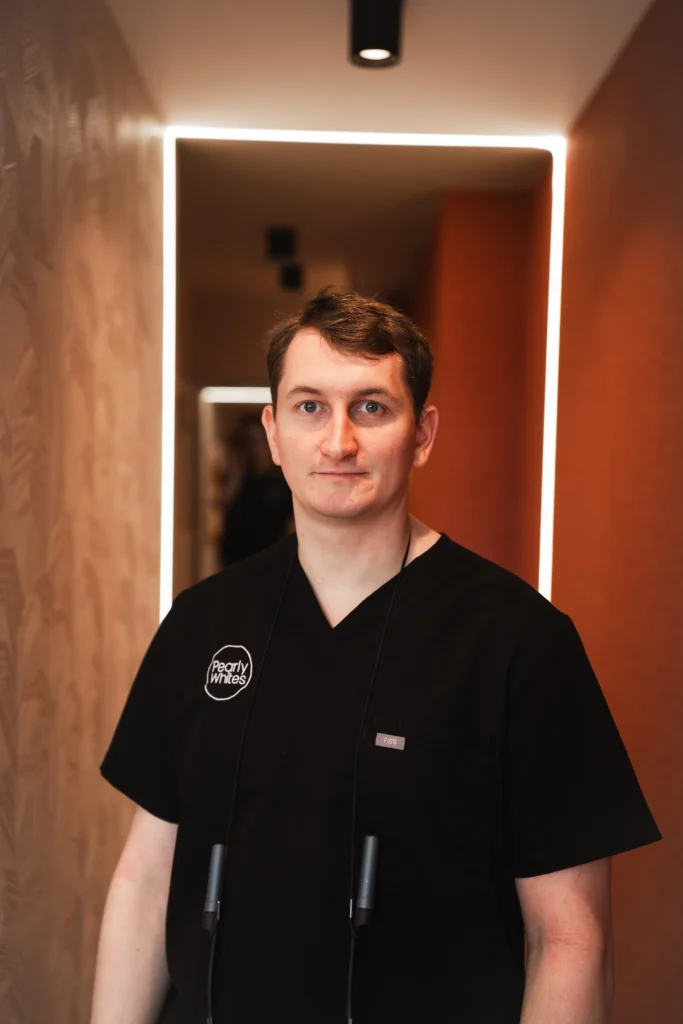


Matthew Bell
Best dental practice we’ve ever had. Had a string of disappointments over the years and Pearly Whites is so well organised and professional.

Gum grafts for receding gums, regenerative surgery to rebuild lost support, and gum reshaping, with Dr Rohan Shaffery, who has a special interest and advanced training in periodontology.
4.6 from 300+ Google reviewsFamily-run practice on Munster Road, SW6
At a glance
Treatments
Covers roots exposed by receding gums with a small piece of your own tissue, usually from the roof of your mouth, thickening the gum for long-term stability.
A gum graft using donor tissue (an allograft) instead of your own, so there’s no second area in your mouth to heal.
For suitable bone defects around a tooth, Emdogain, a protein-based gel, encourages your body to rebuild lost bone and reattach the gum to the tooth.
If deep pockets remain after gum disease treatment, surgery can reduce them so they’re easier to keep clean. Many people never need it.
Gently reshaping a small amount of gum, for example so a new crown has a clean, healthy edge.
Thickening thin gum can help mask a grey shadow showing through from an old metal post or restoration.
Receding gums
Gum recession is when the gum gradually draws back from a tooth, exposing some of the root. It usually comes from a combination of naturally thin gum, the position of the tooth, and years of brushing a little too firmly, as well as gum disease. Exposed roots are a darker, more yellow shade than enamel, which is what makes teeth look longer, and they can be sensitive.
If recession isn’t causing you problems and the appearance doesn’t bother you, doing nothing is a completely valid choice: we keep an eye on it and help you adjust your brushing so it doesn’t get worse. If it does bother you, or the gum is thin and at risk, a gum graft addresses it directly.
Connective tissue graft
Under local anaesthetic, Dr Rohan takes a small piece of connective tissue from the roof of your mouth, which is thick and heals well, and places it over the exposed root, tucking it under your existing gum and securing it with fine stitches. Over the following weeks, it blends in and takes on the colour and texture of your natural gum, leaving a gum line that sits lower and is thicker than before.
The appointment takes around an hour to an hour and a half, and you’re numb throughout. Afterwards, the roof of the mouth is usually the most tender part, a bit like a mild burn, for three to five days, and most people manage with everyday painkillers and soft food. A custom-made protective plate to cover the roof of your mouth while it heals is available. We see you again to check your healing.
In favourable cases, a graft covers the root completely; in others, it gives a significant improvement without covering every last millimetre. It depends on the bone and gum between your teeth, and Dr Rohan will give you a realistic picture before you decide.
Which graft?
| Feature | Connective tissue graft | Donor tissue graft |
|---|---|---|
| Where the tissue comes from | The roof of your own mouth | Donor tissue (an allograft) |
| Evidence | The gold standard, with the most predictable, long-lasting results | Less well evidenced for long-term results |
| Recovery | The roof of the mouth is tender for a few days | No second area to heal, so often more comfortable |
| Our recommendation | Usually our first choice | A good option if you’d rather avoid a second site |
Regenerative surgery
Gum disease can leave defects in the bone around a tooth. For defects of the right shape, Dr Rohan can use Emdogain, a protein-based gel, to encourage your body to rebuild lost bone and reattach the gum to the tooth.
No one can guarantee regenerative surgery, because the result depends on how your own bone and gum heal. What improves the odds is healthy gums going into surgery and consistent care afterwards.
Before surgery
Any gum disease is treated first, and your gums need to be clean and free of inflammation before surgery.
Gum disease treatment →Where needed, a 3D scan shows the bone and anatomy underneath, taken at a specialist imaging centre at a preferred rate for our patients.
Sometimes a tooth sits outside the bone, and moving it back into position with Invisalign first gives a graft a much better chance of lasting.
Invisalign →Your treatment
Dr Rohan examines your gums, measures the pockets and recession, takes X-rays and explains your options, including doing nothing, honestly.
We make sure your gums are healthy, with a hygiene visit or gum disease treatment first, and arrange a 3D scan if needed.
Carried out here at the practice under local anaesthetic, so you’re numb throughout.
Most people feel tender for a few days and manage with everyday painkillers and soft food. We give you clear aftercare advice.
We see you again to check your healing, and then keep your gums healthy with regular cleans.
Your dentist
Dr Rohan has a special interest and advanced training in periodontology, oral surgery and implantology, and is a member of the British Society of Periodontology and Implant Dentistry. After graduating from King’s College London, he completed a Master’s in Clinical Implantology and became a Member of the Faculty of Dental Surgery at the Royal College of Surgeons of Edinburgh.
He carries out all our gum surgery here at the practice, and will always tell you honestly whether surgery is worthwhile.
Costs
Gum surgery is available with 0% finance over 12 months, or longer terms with interest, subject to approval: see dental finance.
Reviews
Best dental practice we’ve ever had. Had a string of disappointments over the years and Pearly Whites is so well organised and professional.
Best dental practive in area..✨️✨️✨️✨️✨️
Always made to feel valued as a patient, Dr Lia is a wonderful dentist.
Dr Lia and Nurse Shukri
Practice manager Zahra were all wonderful- I actually look forward to coming to the dentist. All so kind & competent & happy.
What a wonderful team! I can’t recommend the Invisalign treatment highly enough in the hands of this capable team. Thank you for all you’ve done over the last few months. A very happy client!
Questions
Not on their own, but a gum graft can cover exposed roots and thicken the gum so it’s more stable. How much of the root can be covered depends on the bone and gum between your teeth.
A small piece of tissue, usually from the roof of your mouth, placed over an exposed root and stitched in place under your gum. It’s the best-evidenced way to treat receding gums.
Every case is different, so Dr Rohan quotes for your treatment at a periodontal consultation, which is £99. 0% finance is available.
You’re numb throughout, so you shouldn’t feel pain. Afterwards, it’s usually tender for a few days, especially the roof of the mouth after a graft, and most people manage with everyday painkillers.
Most people are tender for three to five days, and the area heals fully over around four weeks.
No. If receding gums aren’t causing problems and the look doesn’t bother you, we can simply monitor them and help you brush in a way that stops them getting worse.
Yes. It avoids a second area in your mouth, but it isn’t as well evidenced for long-term results as your own tissue.
A protein-based gel used in regenerative surgery, which encourages your body to rebuild lost bone and reattach the gum to the tooth, for bone defects of the right shape.
No one can guarantee it, as the result depends on how you heal. What improves the odds is healthy gums going into surgery and good care afterwards.
If you have active gum disease, yes. Surgery works best on healthy gums, so we treat any gum disease first.
Dr Rohan Shaffery, who has a special interest and advanced training in periodontology, here at the practice.
Book a consultation with Dr Rohan, and he’ll explain your options honestly.